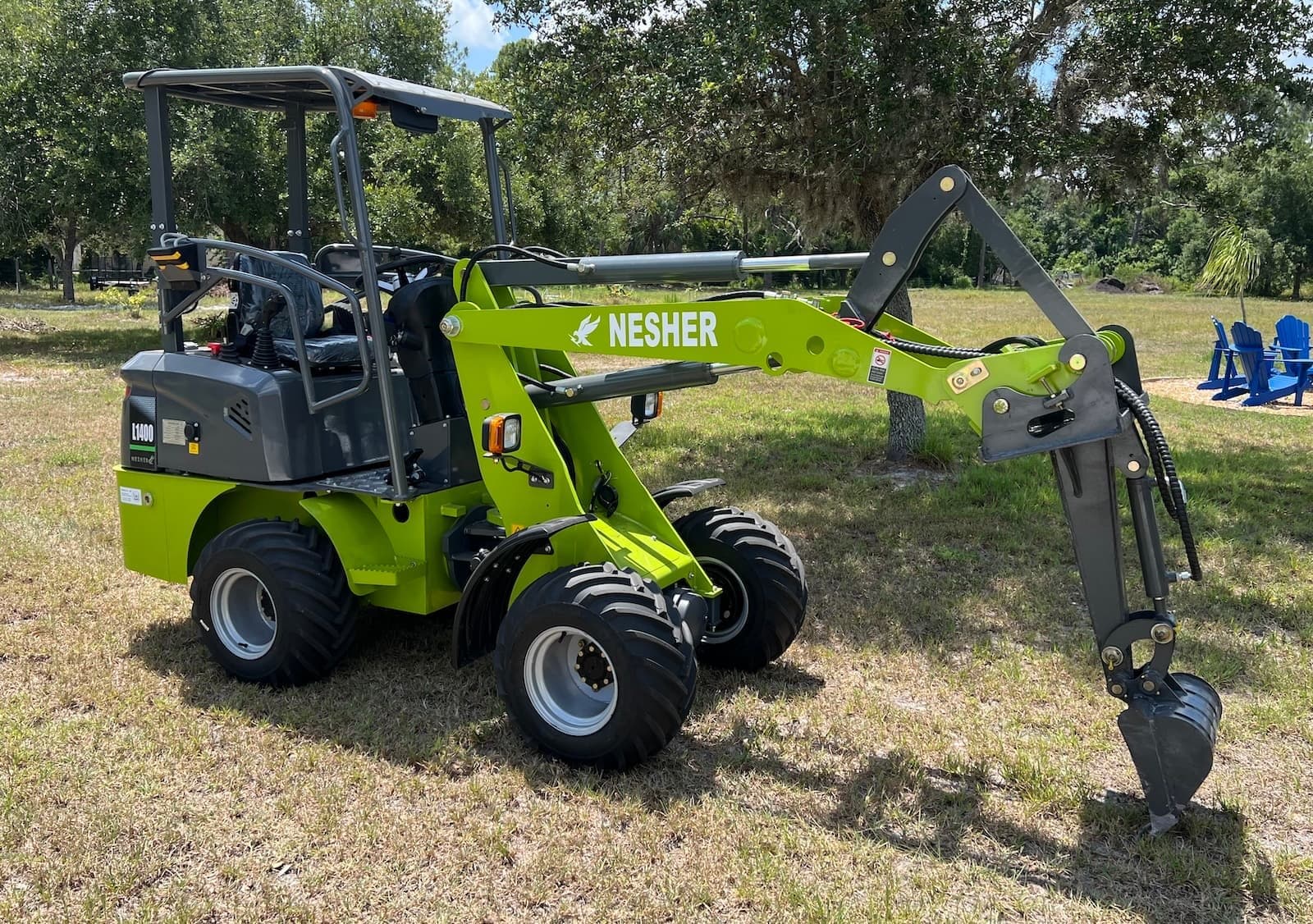
Short answer: for landscaping on lawns, pavers and backyards, an articulated loader usually does less damage: it bends in the middle, so its four wheels roll through turns instead of skidding. A skid steer turns in its own footprint, has a much bigger attachment ecosystem and lifts more for its size, but tears up turf on every turn. On the electric side, articulated loaders like Nesher's are available now; from Bobcat, the tracked T7X is sold in select markets and the wheeled S7X is announced.
The two machines side by side
| Articulated loader | Skid steer | |
|---|---|---|
| How it turns | Bends in the middle: all four wheels roll through the turn | Wheels on one side slow or reverse: the machine pivots by skidding |
| Lawns and pavers | Little damage when turning | Tears turf and marks finished surfaces on every turn |
| Room to turn | Needs a turning radius (about 7 to 8 ft on the L1400 and L880) | Turns in its own footprint |
| Getting in | From the side | Usually from the front, over the attachment |
| Attachments | Each maker's own range: check compatibility | Huge choice thanks to the universal quick-attach plate |
| Electric version | Nesher, EcoTrack, GiANT and others | Bobcat T7X (tracks); the wheeled S7X is listed as "coming soon" |
When to choose an articulated loader
Grounds maintenance, nurseries, finished landscapes, moving pallets of pavers or bags, topsoil and mulch across a lawn: any job where what the machine leaves behind matters as much as what it carries. An electric articulated loader adds two advantages on a residential job: no exhaust next to houses and far less noise. The L880 (40" wide) suits small yards; the L1400 lifts more and can have a heated cab.
When to choose a skid steer
Excavation, demolition, grading large areas, working where you must turn in place, or if you already own a fleet of universal quick-attach attachments. On soft ground, a track loader spreads its weight better, but its tracks also mark the ground when turning.
What changes with electric
Electric compact articulated loaders often charge on an ordinary 120 V outlet: Nesher loaders, for example, plug into a garage outlet with no charging station. Larger electric skid steers and track loaders need a more powerful supply. See our guide to charging on 120 V and our comparison of electric compact loaders in Canada.
Frequently asked questions
Does an articulated loader damage lawns?
Far less than a skid steer. Because it bends in the middle, its four wheels roll through turns instead of skidding. Like any machine, it can still leave marks on waterlogged ground.
Can an articulated loader dig?
For small jobs, yes: the L880 and L1400 take a digger arm and an auger. For heavy excavation or large-scale grading, a bigger machine is more efficient.
Is there an electric skid steer?
Bobcat sells the T7X, an electric compact track loader, in select North American markets, and lists the wheeled S7X as coming soon. Bobcat says both charge on 240 V, 50 A service.
Which one fits through a backyard gate?
Measure the gate. The L880 is 40" wide and the L1400 3'10". For very tight access, a stand-on utility loader like the Toro eDingo 500 (30 in wide without the bucket) fits where a ride-on loader won't.