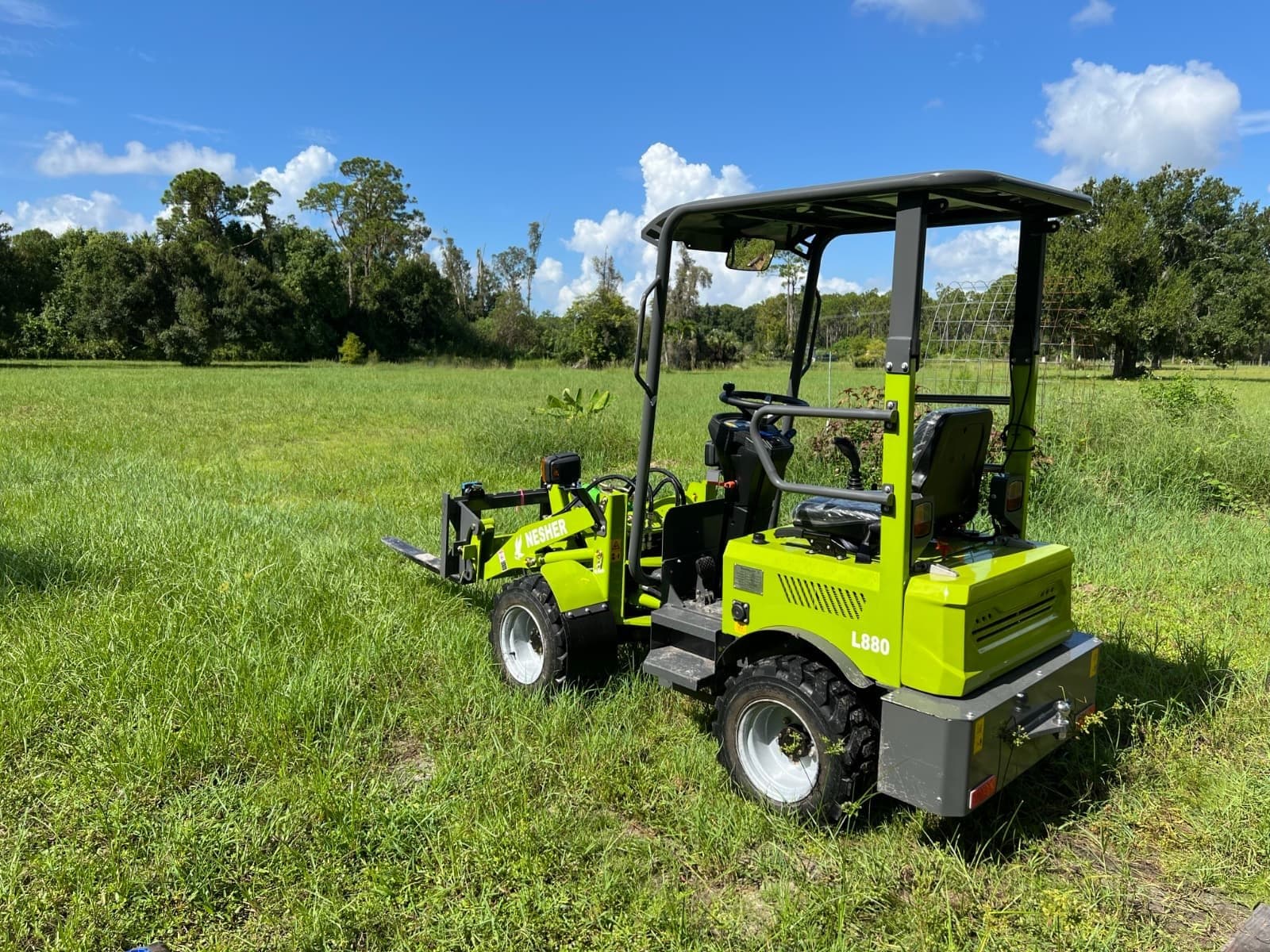
Short answer: yes, Nesher electric compact loaders charge on an ordinary 120 V outlet, like the one in your garage. No charging station, no electrician. On a 15 A circuit, a full charge from empty takes about 8 hours for the L880, 12 for the L1400 and 20 for the L2500, and costs a few dollars of electricity.
Charge time and cost, by model
| Model | Standard battery (AGM) | Full charge, 120 V / 15 A | Cost in Quebec | Cost in Ontario |
|---|---|---|---|---|
| Nesher L880 | 9 kWh | about 8 h | $1.36 | $1.18 |
| Nesher L1400 | 14.4 kWh | about 12 h | $2.17 | $1.88 |
| Nesher L2500 | 25.4 kWh | about 20 h | $3.82 | $3.32 |
Cost of a full charge from empty at Hydro-Québec Rate D and Ontario's off-peak rate, including charging losses. Most days you don't start from empty: a top-up after half a day takes less time and costs less.
Why charging takes this long
A 120 V, 15 A outlet delivers about 1.4 kW continuously, roughly 1.3 kW of which reaches the battery. So charge time follows battery size: the L880's 9 kWh refill overnight, while the L2500's 25.4 kWh take about 20 hours. It's the same reason an electric car plugged into a regular outlet charges slowly.
What the outlet needs
A standard outlet in good condition, ideally on a circuit where nothing else draws much power while the loader charges (no block heater, compressor or space heater on the same breaker). Outdoors, use a GFCI-protected outlet. Avoid extension cords; if you must use one, keep it short and heavy-gauge.
Charging faster: Level 2
If you work long days back to back, especially with the L2500, some LFP battery upgrades support Level 2 (240 V) charging, for a full charge in 4 to 6 hours. The LFP pack also adds run time per charge. See the options on each model's page or ask us.
Winter
A cold battery accepts charge more slowly and gives less run time. Store and charge the machine indoors when you can. See what we know about winter.
What about other electric loaders?
Not all of them plug into a regular outlet. The Toro eDingo 500, a stand-on utility loader, charges on 120 V, 15 A. Bigger machines need more: the Volvo L20 Electric uses a more powerful onboard charger or a fast charger, and Bobcat lists 240 V, 50 A service for the T7X. Our guide to electric compact loaders in Canada compares them.
Frequently asked questions
Can you charge an electric compact loader on a regular outlet?
Yes. All three Nesher loaders charge on a standard 120 V outlet, with no charging station or special installation. A full charge from empty takes about 8 hours for the L880, 12 for the L1400 and 20 for the L2500.
Do I need an electrician?
Not to charge on 120 V. Ideally use an outlet on a 15 A circuit where nothing else draws much power while the loader charges. If a breaker trips, have an electrician check the circuit.
Can I use an extension cord?
Plug straight into the outlet if you can. If not, use a short, heavy-gauge, outdoor-rated cord, fully unrolled, and never two cords end to end.
Can I charge in the cold?
Yes, but store and charge the machine indoors when you can: a cold battery accepts charge more slowly and gives less run time.
Can I charge faster?
Some LFP battery upgrades support Level 2 (240 V) charging, for a full charge in 4 to 6 hours. Ask us which ones suit your model.