It's the question we get most: "Does it work in winter?" Yes, with less run time. Here is what we know, what we have not measured yet, and how to plan around it.
Batteries and cold
Nesher loaders come standard with AGM batteries, a sealed, maintenance-free type of lead-acid battery. Like any battery, they deliver less energy when it is cold. The advertised 4 to 6 hours of run time applies in mild weather; in deep winter, plan for shorter work sessions.
We have not yet published a measured winter run time for these machines. When we have one, it will be on this page, with the temperature, the work done and the hours achieved. Until then, be wary of any table that promises a precise figure at -20°C, including ours.
What helps in winter
Store and charge the machine indoors when you can. A warmer battery gives more run time and charges better.
Keep the battery charged between uses.
Plan short sessions. Clearing a driveway, feeding animals, moving pallets: jobs of an hour or two suit the machine well. A storm that needs eight straight hours of plowing is more than one charge can give.
Plan the recharge. On a 120 V, 15 A outlet, a full charge takes about 8 hours for the L880, 12 for the L1400 and 20 for the L2500.
Where electric helps in winter
Indoor work. With no exhaust, the loader can work inside a barn, garage or closed warehouse, where much of winter's work happens.
No cold starts. There is no block heater to plug in, no fuel to gel and no engine to warm up.
Snow clearing. A snow plow is available for the L880 and L1400. See our snow removal guide.
Heated cab
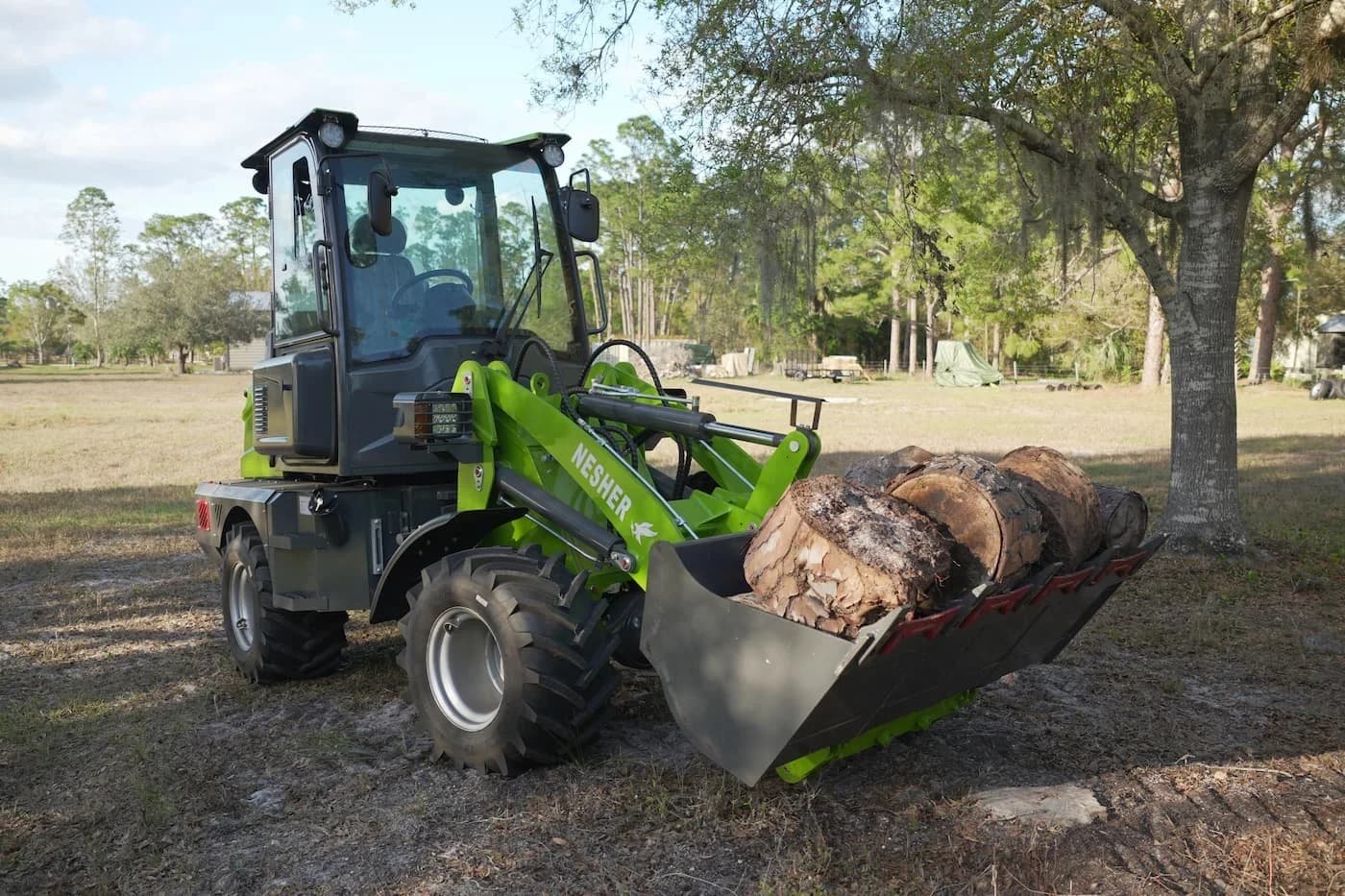
The L1400 can be ordered with an enclosed, heated cab, and the L2500 includes one. Heating draws energy from the battery, which also reduces run time.
The bottom line
An electric loader works in winter, with less run time than in summer. For short jobs near a building where you can charge it, it is practical. For long days of commercial snow removal, check with us first that the run time fits.
Contact us about your winter use, or build your loader.