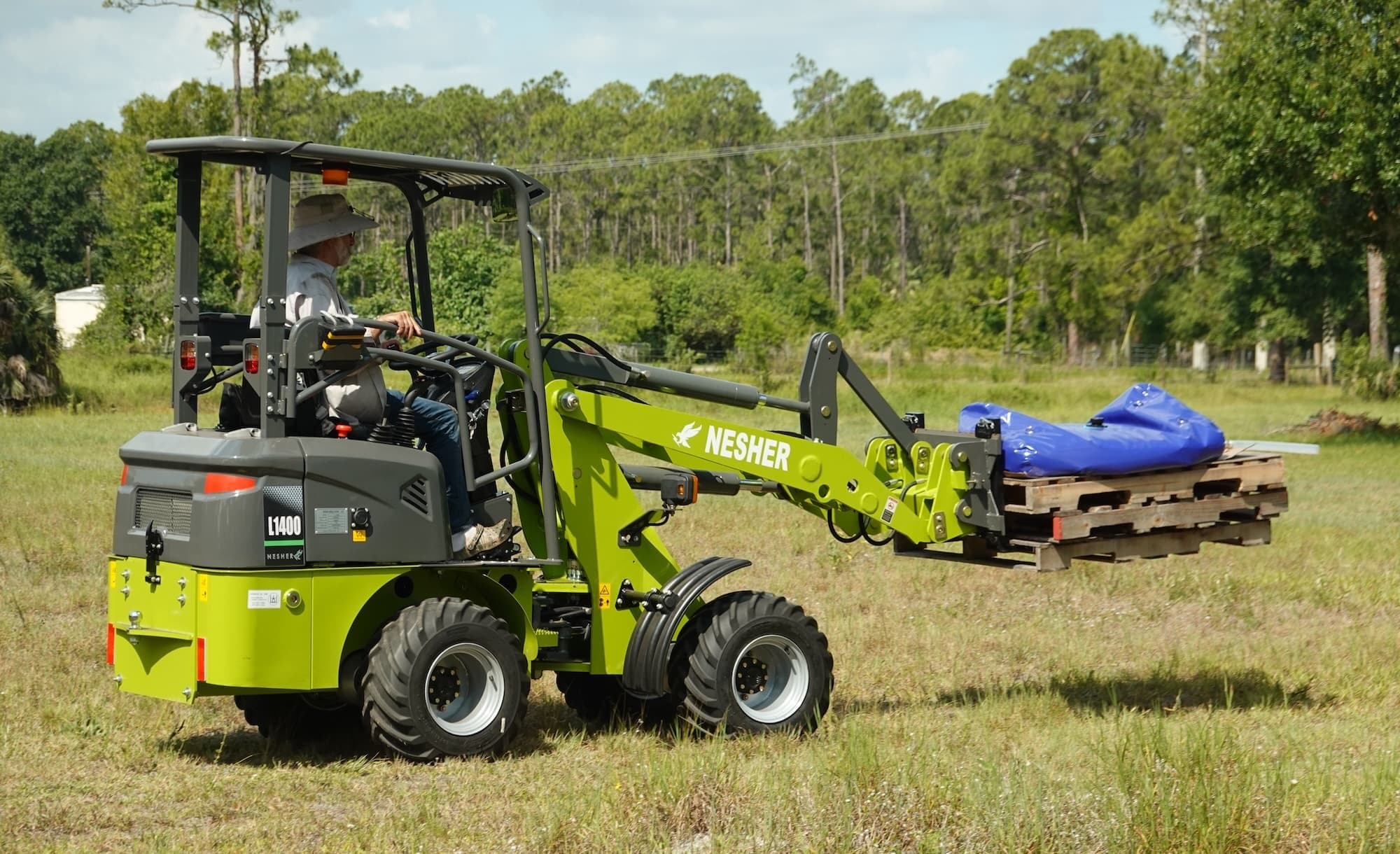
If you're shopping for a compact loader in Canada, you've noticed electric models gaining ground. Here is what the numbers actually say, what they don't, and where diesel is still the better choice.
Fuel versus electricity
This is where the gap is widest. For the week of September 28, 2026, pump diesel averaged $2.903/L in Quebec and $2.506/L in Ontario, taxes included. A Nesher loader charges from a standard 120 V outlet for a few dimes per hour of work.
The table shows the estimated fuel saving for each model against a diesel machine of similar size doing light work. Every assumption is printed under it.
| Model | Compared with | Quebec, per hour | Ontario, per hour | Quebec, 300 h/yr | Quebec, 1,000 h/yr |
|---|---|---|---|---|---|
| L880 | a diesel of about 25 hp, 3 L/h | $8.37 | $7.22 | $2,510 | $8,370 |
| L1400 | a diesel of about 35 hp, 5 L/h | $13.97 | $12.06 | $4,190 | $13,970 |
| L2500 | a diesel of about 50 hp, 7 L/h | $19.36 | $16.71 | $5,810 | $19,360 |
Estimated fuel saving only, week of September 28, 2026. Pump diesel, taxes included: $2.903/L in Quebec (Régie de l’énergie du Québec) and $2.506/L in Ontario (provincial survey). Electricity, taxes included: 12.8¢/kWh in Quebec (Hydro-Québec Rate D) and about 11.1¢/kWh in Ontario (off-peak, estimate). Diesel use is calculated for light work with a standard formula; it is not a measurement of a particular machine. The comparison holds for work a Nesher loader can do. Your results will vary with your hours, your work and prices.
Three limits to keep in mind. The diesel burn rate is a formula estimate, not a measurement. The comparison only holds for work an electric loader of this size can do. And hours matter more than anything: the calculator below starts at 300 hours a year; enter your own.
Estimate your fuel saving
Change any number to match your own machine, hours and prices.
default for a diesel of about 25 hp
- Diesel per year
- $2,613
- Electricity per year
- $102
Estimated fuel saving per year
$2,511
$8.37 per hour of work
Estimate of fuel cost only. Diesel defaults are the provincial pump averages for the week of September 28, 2026; the default burn rate is a formula estimate for a diesel of the size shown, at light work. Electricity use assumes the battery is emptied in the shortest advertised run time. It does not cover purchase price, maintenance or financing.
Purchase price
The L880 sells for $19,990, the L1400 for $35,000 and the L2500 for $65,000, general bucket included, before taxes. A diesel sub-compact tractor with a front loader from the major brands lists at roughly $22,000 to $29,000 in Canada (manufacturer and dealer list prices, October 2026). So the L880 costs the same as or less than the machine it replaces for loader work, which is unusual for an electric machine.
For the L1400 and L2500, the right comparison is a diesel articulated loader of similar capacity. Ask for a quote on both and compare at equal capacity.
Maintenance
An electric loader has no engine oil, no fuel filters, no engine coolant and no belts. What remains is what any loader needs: the hydraulic system, tires, pivots, brakes and the battery. We don't publish a dollar figure for maintenance savings, because no independent measurement exists for these machines.
What electric does well
No exhaust where you work. You can work inside a barn, greenhouse, warehouse or closed garage.
Far quieter than a diesel engine. That matters near animals, neighbours and customers.
No fuel to manage. No jerry cans, no tank, no deliveries. The machine plugs into a 120 V outlet.
Where diesel still wins
A Nesher loader runs 4 to 6 hours per charge, and a full recharge takes about 8 hours for the L880, 12 for the L1400 and 20 for the L2500 on a 120 V, 15 A outlet. If you work full days back to back, need to refuel in five minutes, or need a PTO for a mower or tiller, a diesel machine fits better. An electric loader is at its best for short, frequent jobs close to a building.
Emissions
Burning a litre of diesel releases about 2.7 kg of CO₂. An electric loader has no exhaust emissions where you work; the emissions from generating its electricity depend on your province's grid.
The bottom line
At today's prices, fuel is the strongest argument, and the L880 has no price premium to justify. For a few hours of daily use, the numbers lean clearly electric. For full days of heavy work, check first that the run time is enough for you.
See also our comparison with a compact tractor and what businesses can deduct, or build your loader.